

Field GuideLate summer pestWasps
Why yellowjackets crash every August barbecue
By late summer, a nest that one queen started in April can hold thousands of workers, and they're hungry for exactly what's on your plate.

Chapter 1
It all started with one queen
Every yellowjacket nest in your yard this summer began with a single queen. Only mated queens survive a Northwest winter, tucked under loose bark, roof shakes or in a firewood pile. The rest of last year's colony died off with the first frosts.
In spring she wakes up, chews weathered wood into paper and builds a nest about the size of a golf ball. She raises the first workers all by herself. After that she never leaves again: she stays inside laying eggs while her daughters do everything else.
Nests are never reused. Every nest you find this year is brand new, and it has been growing quietly since April.

Chapter 2
From one to five thousand
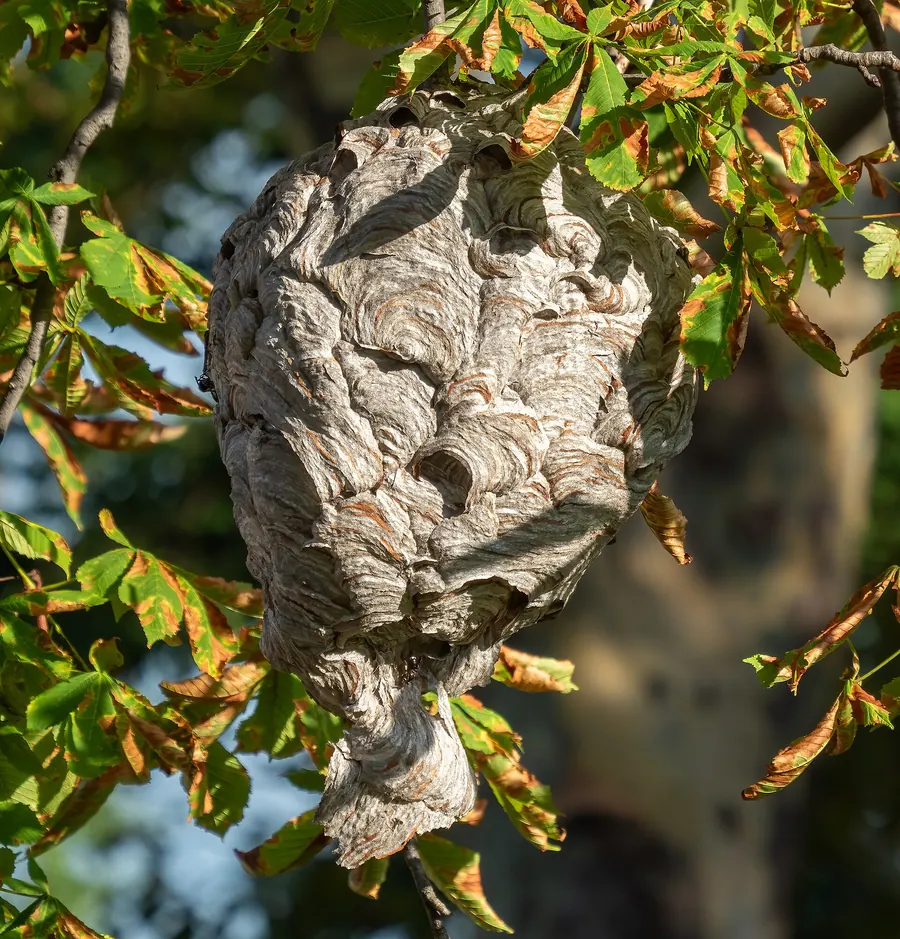
One summer is all it takes. By August a single yellowjacket nest can hold up to 5,000 workers and 15,000 paper cells.
One queen in April → up to 5,000 workers in August
Each dot = 10 workers · WSU Extension, EB0643
Peak season Active Today
Chapter 3
Why it's always August
Colonies reach full size in August and September, when worker numbers are at their peak. That's also when they're most troublesome around people.
There's a second reason they find your plate. Late in the season the nest raises fewer young, and fewer flowers are blooming, so the workers likely switch to hunting sugar and protein wherever they can find it: soda cans, fruit, burgers, the trash can.
German yellowjackets peak even later, in October and early November, and some last until late November.
Chapter 4
Meet the usual suspects
Tap a card to flip it. Three of these are the troublemakers. One is innocent.


By the numbers
Small wasps, big numbers
1,000+
wasps in a nest a foot or more across, by September
WSU Extension
1–2%
of people are severely allergic to yellowjacket venom
PNW Insect Handbook
~1,100 ft
how far foragers usually travel from the nest, so the nest is often next door to your table
OSU Extension
Myth vs fact
Things everyone gets wrong
Tap a card to bust the myth.

Before you grab the hose
What not to do
- Don't plug the holeA blocked nest inside a wall doesn't give up. The wasps chew their way out, sometimes straight through the drywall into your house.
- Don't mow over it or swatMower vibration can set off hundreds of wasps from a ground nest. A crushed yellowjacket releases an alarm scent that tells the others to attack, and it can mark you for hours.
- Don't spray the flyers, and never use fire or gasolineSpraying wasps in the air doesn't solve anything and gets people stung. Fire and gasoline are dangerous and illegal.
Leave it or call?
When it's time to call us
To be fair to the wasps: extension experts call them beneficial insects, and a nest far out in the back acreage, away from people, can be left alone. It's a different story when the nest is by a doorway, under the deck or near where kids play.
Close quarters
Nests in attics and walls are hard to reach and often far from the entrance hole. Washington State University advises calling a professional, because people working on them are often badly stung.
Allergies in the family
If anyone in your home is allergic, or the nest is hard to reach, the Washington State Department of Health says to hire a pro.
Found, treated, done
We find the nest, not just the wasps, treat it properly and tell you what to watch for. Our pricing is based on the inspection, not by the hour.
Emergency: Call 911 for anyone stung who has trouble breathing, swelling of the face, mouth or throat, or feels faint.
Wasps/Hornets Inspection
Yellowjackets around the deck?
Book a Wasps/Hornets Inspection and we'll find the nest and take care of it. Local technicians, Clark County, Cowlitz County and Portland.

Sources (11) and photo credits
- Washington State University Extension, EB0643: Yellowjackets and paper wasps
- WSU Puyallup, Common wasps of the Pacific Northwest
- PNW Insect Management Handbook: wasps and bees
- Oregon State University: Yellowjackets and wasps
- OSU Extension EM 9211: Protecting honey bees from yellowjacket wasps
- Ask Extension: hornets in Oregon
- Washington State Department of Health: bee and wasp stings
- Cornell IPM: Yellowjackets and baldfaced hornets
- Penn State Extension: German yellowjackets
- University of Illinois Extension: Why are there so many yellowjackets in fall?
- Alabama Cooperative Extension: outdoor stinging insects
Photos: Judy Gallagher (CC BY 2.0), Bernie (Wikimedia Commons) (Public domain), Judy Gallagher (CC BY 2.0), Bernie (Wikimedia Commons) (Public domain), Rhododendrites (CC BY-SA 4.0). Cover and house scenes are AI-generated illustrations.
This article is general information about pests in the Pacific Northwest, not a substitute for an on-site inspection.